
Johnson County Arrest Warrants Explained
An arrest warrant is a court order that lets an officer take someone into custody. Before a justice or municipal judge in Johnson County signs one, Texas procedure demands a sworn complaint or affidavit grounded in probable cause. Felony warrants belong to the district courts. JPs wear a second hat as magistrates. That means they can issue search or arrest warrants too. Paper from a district court lives with the District Clerk, while a JP or municipal case stays with the court that issued it. One thing to know: Johnson County posts no countywide arrest-warrant roster for the public.
Johnson County Felony Warrants Start With the District Clerk
For felony warrant records, the Johnson County District Clerk is the office to call. Its files cover criminal warrants, judgments, sentences, protective orders, and bail-bond forfeitures, and it serves the 18th, 249th, and 413th District Courts. The 18th and 249th also serve Somervell County. The 413th serves Johnson County alone. Ask the clerk which court owns the file and whether the document you want is on hand. A county portal may help you find the docket number. The clerk or court coordinator is the one who confirms the warrant record. The Johnson County District Clerk page spells out the office's records scope and how to reach it.
Inside a Johnson County Arrest Warrant
Johnson County publishes no countywide format or sample number for arrest warrants. When you request a file, ask for the warrant instrument, the sworn complaint or affidavit behind it, the issue date, the court and judge, the offense description, the execution return, bond or appearance details, and any recall order.
| Request reference | Case number is the known identifier to provide; no local warrant-number format was located. |
|---|---|
| Instrument | Ask for the signed arrest-warrant document and the court that issued it. |
| Supporting record | Request the complaint or affidavit separately; access may depend on execution and exceptions. |
| Return / service | Ask for the execution or return record and whether process was served. |
| Bond / appearance | Confirm case-specific terms with the issuing court or magistrate. |
| Current status | Ask whether the court has recalled, withdrawn, or otherwise closed the order. |
Johnson County JPs May Act as Magistrates
Johnson County runs four Justice of the Peace precincts. Those courts hear fine-only misdemeanor and civil cases. JPs also act as magistrates, so they can issue search or arrest warrants themselves. Keeping the court file is the clerk's job. Issuing paper is the JP's. If your case paper names a precinct, call that JP court for the order and its status. A city citation never belongs at the District Clerk just because it arose inside Johnson County. The county JP overview explains this local court layer.
Serving Arrest Warrants in Johnson County
Serving a warrant and keeping its record are two different jobs. The Johnson County sheriff and local police serve criminal process within their own roles. Constables handle Justice Court process. City marshals take care of their municipal court warrants. So the office that serves an order is often not the clerk who maintains the case file. The sheriff's public pages cover patrol, courthouse, corrections, transport, records, and open-records duties, but they list no dedicated public warrant unit and no county walk-in surrender process. Before you show up anywhere in Johnson County, ask the issuing court what to expect.
Johnson County Warrant Service and Local FTA Terms
Burleson's Municipal Court spells out what a missed date can trigger: an alias warrant, a failure-to-appear fee per offense, and in some cases a separate Class C FTA charge. Those are Burleson rules. They are not a countywide rule for every Johnson County court. A new arrest warrant on a city citation is still far from felony process, and only the issuing court can confirm what you face. Read the notice carefully and note which court issued it. If your date has passed, call that clerk. The clerk can tell you whether a warrant went out and whether the court will take a continuance or other setting request. The Burleson appearance page states the city's court-of-record deadline and its local FTA terms.
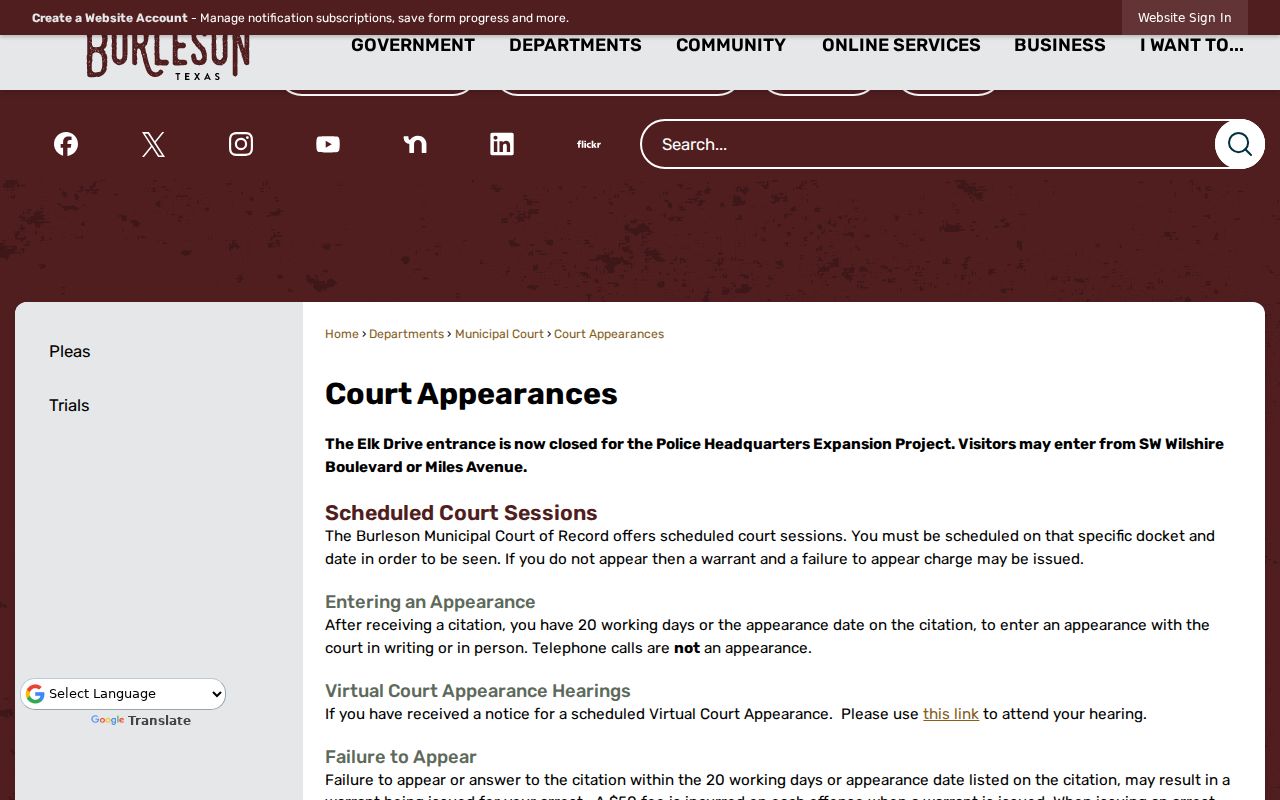
This local deadline example should not be applied to another city or court.
Comparing Arrest, Summons, and Bench Warrants
Three tools do three different jobs. An arrest warrant authorizes custody. A summons or citation just directs a person to respond to a case. A bench warrant follows a missed court obligation, such as failing to appear or ignoring an order. Johnson County pages sometimes use arrest-warrant wording for a missed initial appearance, so confirm the actual instrument with the issuer.
| Feature | Arrest Warrant | Summons | Bench Warrant |
|---|---|---|---|
| What it orders | Arrest under judicial authority | Respond or appear as directed | Arrest after a missed court obligation |
| Common basis | Sworn complaint or affidavit | Citation or court notice | Failure to appear or comply |
| Record route | Issuing court and clerk | Court named on the citation | Court that set the underlying case |
| Next step | Confirm with the issuer and seek legal advice | Follow the notice’s appearance terms | Ask about setting, recall, bond, or payment |
Executed Johnson County Arrest Warrants Become Public Records
Under Texas Code of Criminal Procedure Article 15.26, an arrest warrant and its supporting affidavit become public information once the warrant is executed, subject to exceptions. The arresting officer does not have to carry the paper at the moment of arrest. If asked, the officer must show it as soon as possible. That rule has limits. It does not promise access to an unexecuted, sealed, juvenile, or active-investigation file in Johnson County. A records request can still seek the non-exempt portions. It can also ask the agency to state its basis for anything withheld. Texas Code of Criminal Procedure Chapter 15 holds the warrant and execution provisions.
Unexecuted Johnson County Arrest Warrants Need Direct Review
Texas Code of Criminal Procedure Article 15.26 opens the door to an executed arrest warrant and its supporting affidavit. That is where the door stops. The rule does not hand over every unexecuted warrant, and it reaches no sealed, juvenile, or investigative record in Johnson County. Ask the clerk who holds the file whether the warrant has been executed. Ask, too, which court or public-record rule governs the document you want. A clerk can route that request. A clerk cannot tell you how to answer the allegation itself. If the case touches you, talk with a Texas attorney before you request materials or act on them.
If There’s an Arrest Warrant for You
Start with a phone call. Contact the issuing clerk or the court coordinator and ask whether the warrant is still active, which office holds it, and what bond or appearance terms attach. A licensed Texas attorney can weigh a surrender, a motion to recall, or a motion to quash, and can help you judge the bond amount. Johnson County matters route through the County Clerk or District Clerk depending on the court. Cleburne and Keene each publish city-specific safe-harbor instructions for turning yourself in. The sheriff has no published countywide surrender procedure of its own. Deputies can confirm what their records show. But they cannot recall a judge's order; only the court can do that.
Important: Confirm current instructions with the issuing court and consider legal counsel before arranging an appearance or surrender.